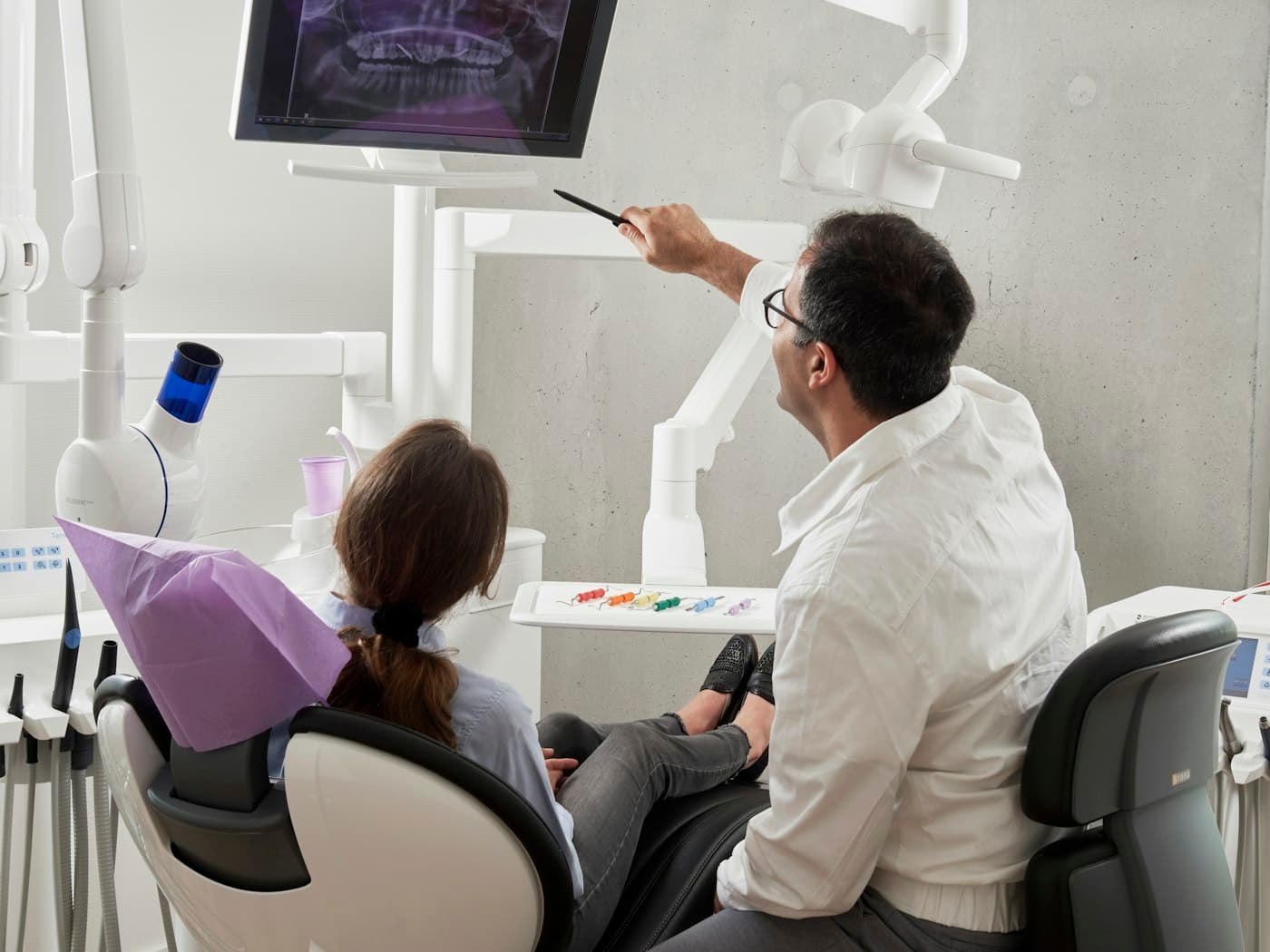
Dentists earn trust by showing the evidence rather than describing it. That means the X-ray on a screen you can see, and the reasoning behind a recommendation before you are asked to agree to it. You get a written plan with costs before treatment starts. You can't check a dental diagnosis yourself, which is why being shown it matters.
In most of medicine you get some independent signal. A broken arm hurts and then stops hurting. A fever drops and you feel it drop. Dentistry gives you much less. A cavity between two back teeth causes no symptoms until it reaches the nerve. Early gum disease rarely hurts at all. By the time a tooth tells you something is wrong, the small version of the fix has usually passed.
So the recommendation arrives with nothing behind it that you can test yourself. You end up reading the dentist instead of the diagnosis. That is an uncomfortable place to make a decision about your own money and your own mouth.
Part of the reputation problem isn't really about individual dentists. It's structural. Dental offices are often judged on how quickly they can move patients through, and treatment recommendations sometimes get made without much explanation of the reasoning behind them. Enough patients have had the experience of being told they need something without being shown why, that a certain skepticism walking into any new dental office is completely reasonable.
What builds trust visit to visit, and how we do it here
- Being shown the X-ray or photo, not just told what it means
- Hearing the reasoning behind a recommendation before being asked to agree to it
- Being told plainly when something can wait, not just when it can't
- Getting a written plan and cost estimate before anything begins
- Getting consistent answers from the same provider, visit after visit
None of this is complicated. It's mostly a matter of a dentist choosing to slow down for a few extra minutes per visit. That is exactly the part that's easy to skip when a schedule is packed.
When we take a digital X-ray or an intraoral photo, we pull it up on the same screen you're looking at and walk through what we're actually seeing. The shadow that indicates decay. The bone level around a tooth. The wear pattern that suggests a grinding habit. You're looking at the same image we are, not taking our word for it.
From there, we explain why a specific treatment makes sense for that specific finding. Not a generic script, but the actual reasoning tied to what's on your screen. If there's more than one reasonable path, watch it for now versus treat it today, we say so, and we let you weigh in on the timing when it's genuinely optional.
Every recommendation gets backed by a written plan and a real cost estimate before any treatment begins. Nothing about your visit turns into a surprise once you're already in the chair.
What you get shown, and what you get in writing
On a digital X-ray, decay shows up as a darker area where the tooth has lost mineral. Bone level shows as the height of the bone against the root. An old filling that has opened at the edge shows as a thin dark line under its border. Once someone points to it, you can usually see it yourself. That is the whole reason for putting it on the screen.
- The specific teeth involved, named or numbered
- What is recommended for each one, and the finding behind it
- The alternative, including leaving it alone for now
- The order of treatment, and what has to happen before what
- A cost estimate, and what your insurance is expected to cover
- What is still unknown until treatment actually starts
You get that in writing before anything begins, and your exact cost is confirmed at your consultation. No published figure can tell you which teeth yours involves, so treat the starting prices on our pricing page as a floor and the written plan as the number to hold us to.
How to tell what can wait
Not every finding needs treating the day it's found. Some early decay can be arrested with better home care and fluoride, then rechecked at your next visit. Some worn fillings hold for years. Telling you that costs the practice today's revenue, which is part of why it's worth hearing.
The other side of that is true as well. When something genuinely can't wait, you should hear why in plain terms, including what's likely to happen if you leave it. A cracked back tooth that is still restorable today can turn into a root canal or an extraction later.
Dentistry has very few decisions that have to be made in the chair. An abscess is urgent. A knocked out tooth is urgent. Almost everything else can wait a day while you read the plan at home.
So a plan that only works if you accept it today is worth a second look. You can take the written estimate away with you. You can ask for copies of your X-rays. You can get another opinion and come back. None of that should cost you your place on the schedule.
Why seeing the same dentist changes what gets watched
Not every finding is a clear yes or no on the day we see it. A shadow can be early decay or it can be a trick of the angle. A tooth can be sensitive without anything showing on the film.
Dr. Shah personally treats Avora Dental patients, from routine exams through complex implant and cosmetic cases. You're not getting a different opinion from a different provider every time you come in. The person reading your X-ray today is the person who saw you six months ago and will see you again in six more.
It also means your history travels with you. The wear pattern we noted last year is the baseline we compare against today. A tooth we agreed to watch is a tooth that actually gets looked at again.
Trust isn't something we ask for. It's something we try to earn back at every single visit, one clear explanation at a time.
What an image cannot settle
An image also has limits, and saying so is part of a real explanation. A film can show that a tooth is cracked without showing how far the crack runs. A shadow can be early decay or it can be the way the beam passed through a contact point. We'll tell you when a finding is clear and when it needs a recheck to become clear.
When that's where we are, we say so. We photograph it, note it, and compare it against the same spot at your next visit. A finding that hasn't moved in a year is different from one that has. Watching something properly is a decision, not a way of avoiding one.
Questions that get you a straight answer
- Can you show me what you're seeing on the image
- What happens if I wait six months
- Is there a less involved option, and why isn't it your first choice
- How many visits, and what happens at each one
- What part of this estimate could change once you start
A dentist who is reasoning from your mouth rather than from a script will answer these easily. If a question gets deflected, that is information too.