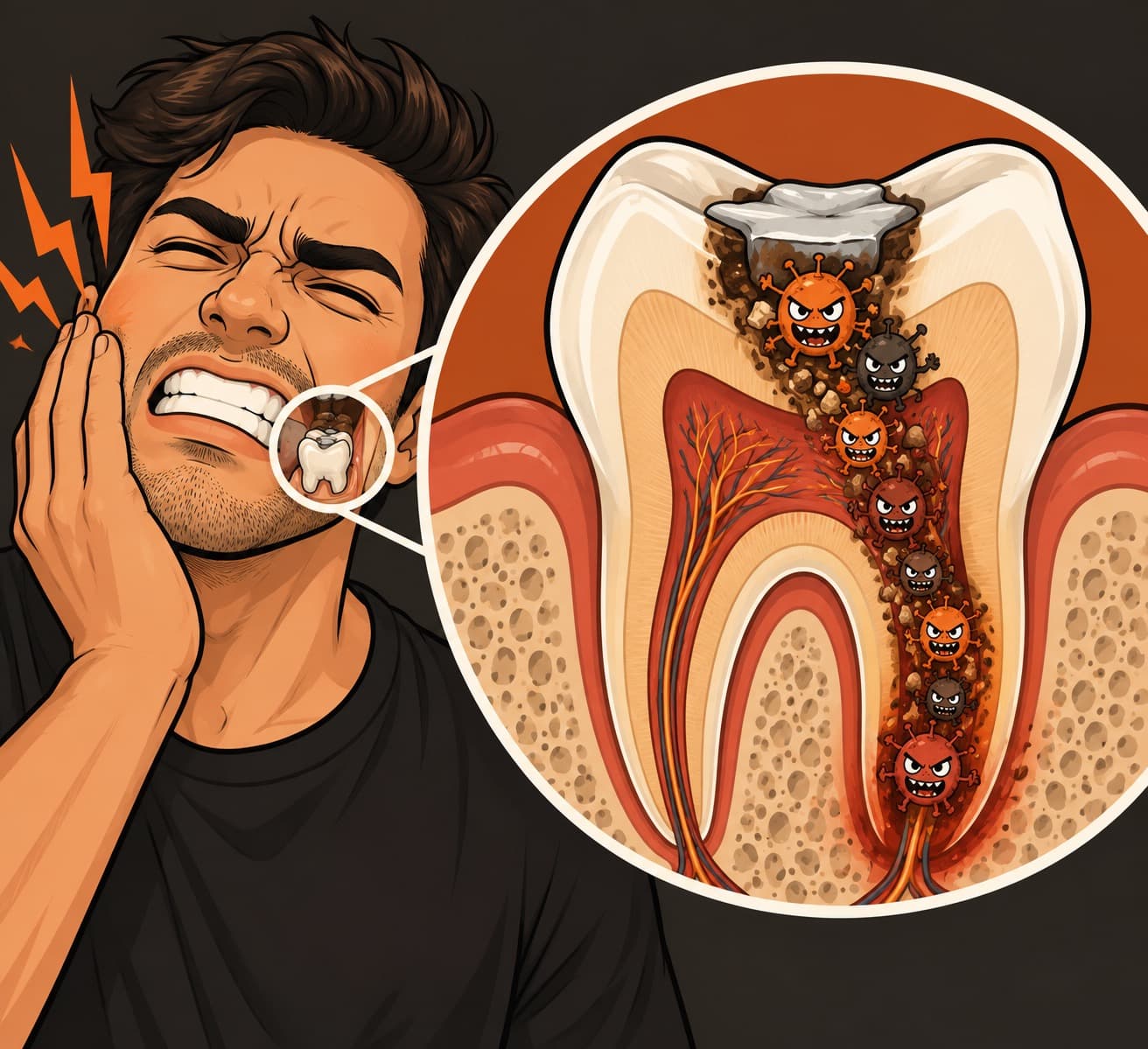
When a bad toothache stops on its own, the nerve inside the tooth has usually died. Dead nerve tissue can't send pain signals, so the ache disappears. The decay and the infection are still there. They keep spreading through the root and into the bone around it. A tooth that stopped hurting needs a dentist, not a wait.
If a tooth of yours has just gone quiet after days of aching, call us at (407) 774-4433 today. Don't wait to see whether the quiet holds. It usually does hold, and that's the problem.
It usually starts small. A rough spot on a tooth, or a tiny divot you can feel with your tongue but can't quite see. For a while, it doesn't hurt enough to do anything about. Then the hole gets a little bigger. And the discomfort that used to come and go starts to stay.
By the time the pain becomes sharp, throbbing, or genuinely hard to ignore, most people know something is wrong. And yet, a lot of patients still don't make it into a dental chair at that point.
Then, for some patients, something strange happens. The pain that felt unbearable just stops. Overnight, or over a few days, it fades to almost nothing. It feels like a reprieve, like the tooth finally settled down and decided to heal itself.
What is happening when the pain disappears
That relief is almost never a sign of healing. It's usually a sign that the nerve inside the tooth has died. Once the nerve tissue is no longer alive, it can no longer send pain signals, which is exactly why the ache seems to vanish. The decay and the underlying infection haven't gone anywhere. They've just moved past the point where that tooth can feel them.
With the nerve dead, the bacteria that were once confined to the inside of the tooth are free to keep spreading. They travel down through the root canal and out through the tip of the root, into the bone around it. That's how a quiet, pain-free tooth can still be actively forming an abscess. An abscess is a pocket of infection and swelling at the root tip, and it keeps growing even while everything feels calm on the surface.
In more advanced cases, that infection can track beyond the tooth and jawbone entirely, into the soft tissue spaces of the face and neck. That's a genuine medical emergency, not just a dental one. It's exactly the outcome that early treatment is meant to prevent.
Why people wait, and what to say when cost or anxiety is the reason
- The cost of treatment feels scarier than the tooth itself, especially without insurance
- Dental anxiety, whether it's a fear of the drill, the needle, or just the chair, which is easier to avoid than face
- Work, kids, and everyday life leave no obvious block of time for an appointment
- A hope that it'll somehow resolve on its own, the way a sore throat sometimes does
- Embarrassment about how long it's been since a checkup, or how bad the tooth has gotten
- A belief that if it isn't unbearable yet, it must not really be an emergency
Every one of those reasons is understandable. None of them changes what the decay is doing inside the tooth.
Say so when you call. It's the most common reason people wait, and it's easier to work with than most patients expect. What the first visit costs is knowable before you come in, and our pricing page lists where the common treatments start, which is usually a smaller number than the one people are carrying around. Financing options are available. An exam and an X-ray cost far less than what the tooth will need once the problem grows.
Tell us that too. We explain each step before we do it, move at your pace, and don't make anyone feel judged about how long it's been. Anxiety is a reason to be seen in a calm office, not a reason to stay home.
What else you might notice, and what happens if you leave it
- Swelling in the gum near the tooth, or a tender lump that comes and goes
- A bad taste or a salty discharge, which can mean an abscess is draining
- The tooth feels tender when you bite on it, or feels slightly taller than its neighbors
- The tooth darkens compared with the teeth either side of it
- Swelling in the face or jaw, which needs same-day attention
Some patients notice none of this. A dead tooth with infection at the root can sit there feeling like nothing at all. The absence of symptoms isn't evidence that the tooth is fine.
The decay keeps eating structure. A tooth that could have been saved with a root canal and a crown becomes a tooth that has to come out. The infection at the root tip keeps working on the bone around it. Taking the tooth out later usually means less bone to work with for a dental implant or a bridge, which makes replacing it harder than it would have been.
Waiting also removes your choices. Early on you have options. Later there's often only one.
What an emergency visit here actually involves
We see this pattern often, because it's such a common and understandable way for a toothache story to unfold. If you're local to Altamonte Springs, Winter Park, Longwood, or the surrounding area, and a tooth has gone from hurting badly to suddenly feeling fine, call us. That's exactly the moment to call, not the moment to relax.
There's no lecture waiting for you at the door. Just a straightforward plan to figure out what's happening and get you comfortable.
- A 3D X-ray to see the full picture: the extent of the decay, the condition of the nerve, and whether infection has already reached the bone
- Anesthesia chosen for a tooth that may already be inflamed, so you're genuinely comfortable during treatment, not just numbed in theory
- A clear explanation of what we're seeing on your scan and what it means, before we recommend anything
- The appropriate emergency care for your specific situation, which may mean root canal therapy to save the tooth, drainage of an abscess, or extraction if the tooth is beyond saving
You'll know what we found and what it costs before anything gets done. If the tooth needs treatment across more than one visit, we'll tell you how many and why.
When the tooth cannot be saved
Sometimes. It depends on how much solid tooth is left above and below the gum, and on what the X-ray shows around the root. Root canal therapy cleans the dead nerve tissue and the bacteria out of the inside of the tooth, then seals it. A crown usually goes on top to hold the rest of the tooth together.
When too much of the tooth is gone, extraction is the honest answer. We'll tell you that rather than charge you for a repair that won't hold. If the tooth has to come out, we'll also talk through how to replace it, because the gap matters for your bite and for the bone.
What to do now
- Call (407) 774-4433 and say the pain stopped. That detail matters, and it changes how we schedule you.
- Book the exam even if the tooth feels completely normal today
- Don't chew on that side until the tooth has been looked at
- Go straight to the nearest emergency room if you have facial swelling, trouble swallowing, or trouble breathing
A tooth that stopped hurting isn't a problem that solved itself. If your pain went away on its own, the most useful thing you can do next is exactly what you'd do if it still hurt: call and get it looked at.