Losing a front tooth is hard enough. When the area around it has also been infected, the options get narrower. This case follows a patient who came to us missing tooth #10, the upper left lateral incisor, and what we did when the first choice for replacing it, a dental implant, wasn't a viable option.
The missing tooth had left a gap in the front of the smile, and with it an infection and a defect at the site. Those details mattered, because they shaped which treatments made sense.
Next to the gap, the patient's front teeth were already restored with crowns. Any replacement for tooth #10 would have to blend in beside them, and that is where the real challenge was.
For a single missing tooth, an implant is often the first thing we consider, because it replaces the root and doesn't depend on the neighboring teeth. But it isn't right for every site. Here, because of the infection and the defect where the tooth had been, an implant wasn't a viable option.
That is a good example of why we plan treatment around your mouth rather than around a default. If you're comparing options for a missing tooth, our dental implant guides explain when each one makes sense.
What can rule an implant out
An implant needs a healthy site to go into. In general terms that means enough bone, in the right shape, with gum tissue that can heal around it and no active infection in the area. Several things can rule a site out or mean extra work first.
- Infection at the site, which has to be resolved before anything is placed
- A bone defect, or not enough bone volume to hold an implant
- Gum disease that hasn't been treated
- Health conditions that affect healing, including uncontrolled diabetes
- Smoking, which also affects healing
Some of those are fixable. Bone grafting can often build up a site that is short on bone, and infection is treated first. Others point to a different plan altogether. An exam and 3D imaging are what tell us which situation you are in, and we would rather say so up front than start down a path that won't hold.
What a modern bridge is made of, and how it works
When an implant isn't an option, many people picture a removable partial denture, the kind that has to come out at night. A fixed bridge is a different thing. It is a replacement tooth, or teeth, joined together and held in place, anchored to the neighboring teeth rather than the jawbone.
Modern bridges are also a long way from the metal-looking bridges many people remember. This patient's bridge was made from porcelain fused to zirconia. Zirconia is a very strong ceramic that forms the core, and layers of porcelain are built over it to give the look and shine of natural enamel.
- It stays in place, so it doesn't have to come out at night
- No removable plastic or clasps to manage
- A strong zirconia core, with porcelain layered over it for a natural appearance
- Shaped and shaded to match the teeth around it
A bridge borrows its support. In general, the teeth on either side of a gap are prepared to carry crowns, and the replacement tooth in the middle is joined to those crowns as a single piece. The whole thing is then cemented in, and it stays there.
That is the real difference from an implant. An implant stands on its own in the bone and leaves the neighboring teeth alone. A bridge involves them. Where those neighbors are already crowned or heavily restored, less healthy tooth structure is at stake in that decision. Where they are untouched and sound, it is a bigger thing to weigh, and we say so.
How the three options compare, and what affects the cost
- An implant replaces the root, helps preserve the bone, and doesn't involve the teeth either side. It needs a healthy site, and it takes longer, because the implant has to fuse with the bone.
- A fixed bridge doesn't rely on bone at the gap or on healing in the jaw. It does rely on the anchor teeth, and it has to be cleaned underneath.
- A removable partial denture usually costs less and involves the least preparation. It comes out at night, and most patients find it less stable than something fixed.
There are situations where each of those is the best available answer. We'll walk through the honest tradeoffs for your case, including when a different option makes more sense than the one you came in asking about.
It depends on how many teeth are involved, the materials used, and what the site needs taken care of first. A bridge, an implant, and a partial denture do not sit at the same price, and our pricing page shows where each of the three starts, which is the honest way to compare them before an exam. Financing options are available.
Why matching a front tooth is the hard part
Matching a front tooth is always a challenge. The eye compares the left and right sides of a smile directly, so small differences in color, translucency, and shape stand out in a way they never would in the back of the mouth. In this case, the bridge had to match tooth #8, one of the central incisors, and blend in with the existing crowns.
Getting that right takes close planning and careful communication with the lab, which is part of why we take detailed photographs at every stage.
Shade is the part patients expect to be difficult. On its own it is rarely the hard part.
- Translucency: natural enamel lets light through near the edge, and flat, opaque porcelain reads as fake even at exactly the right color
- Surface texture, which decides how a tooth catches light rather than what color it looks
- Shape, and the precise line of the biting edge, which the eye compares against the matching tooth on the other side
- The gum line, since a tooth that sits slightly higher or lower than its twin gets noticed
- The neighbors, because a new restoration has to agree with whatever is already in the mouth
This is why photographs and close communication with the lab matter so much on a front tooth. The technician is matching something they can't see in person, so whatever we send has to carry all of it.
What the result looked like, and how a bridge is cleaned
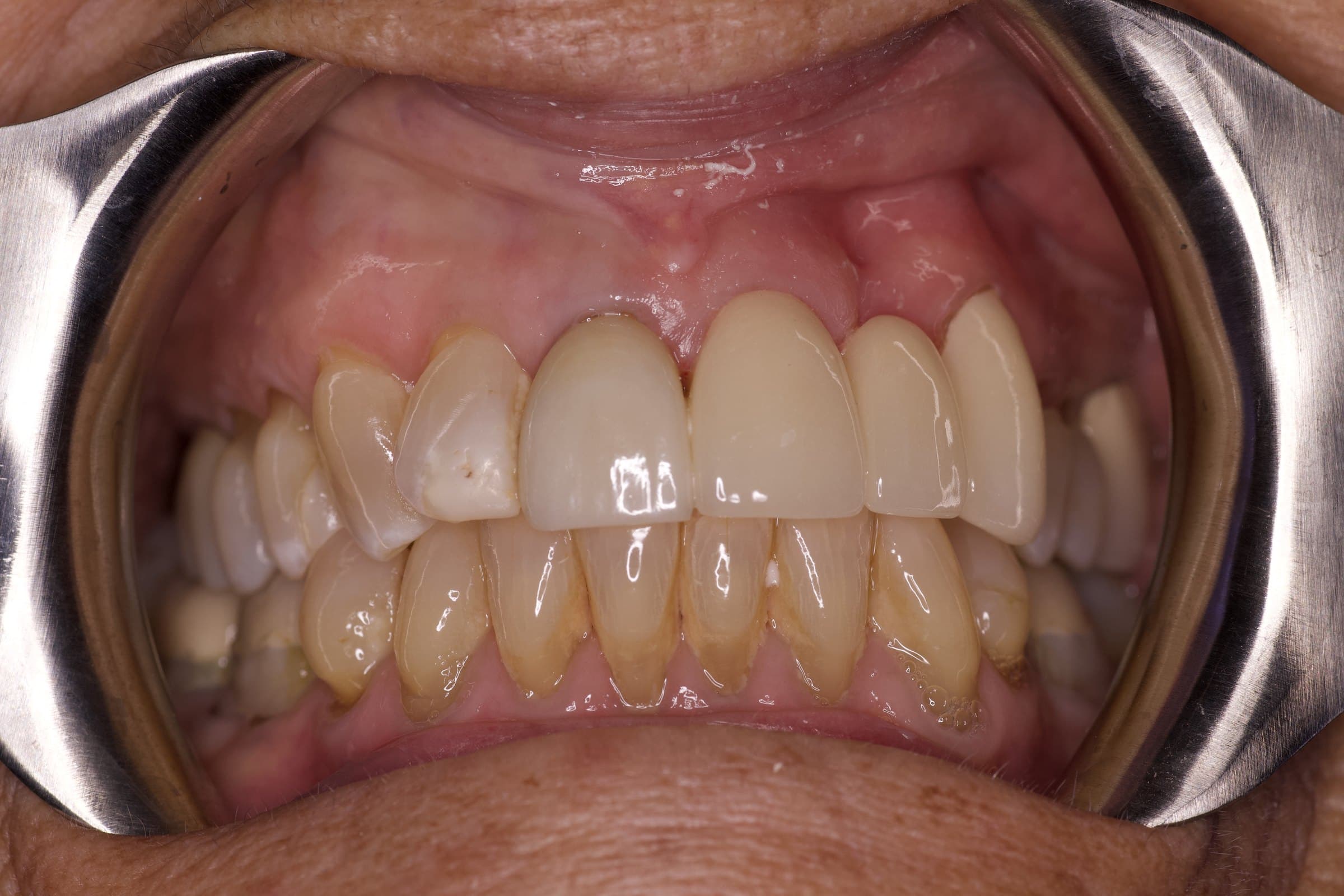
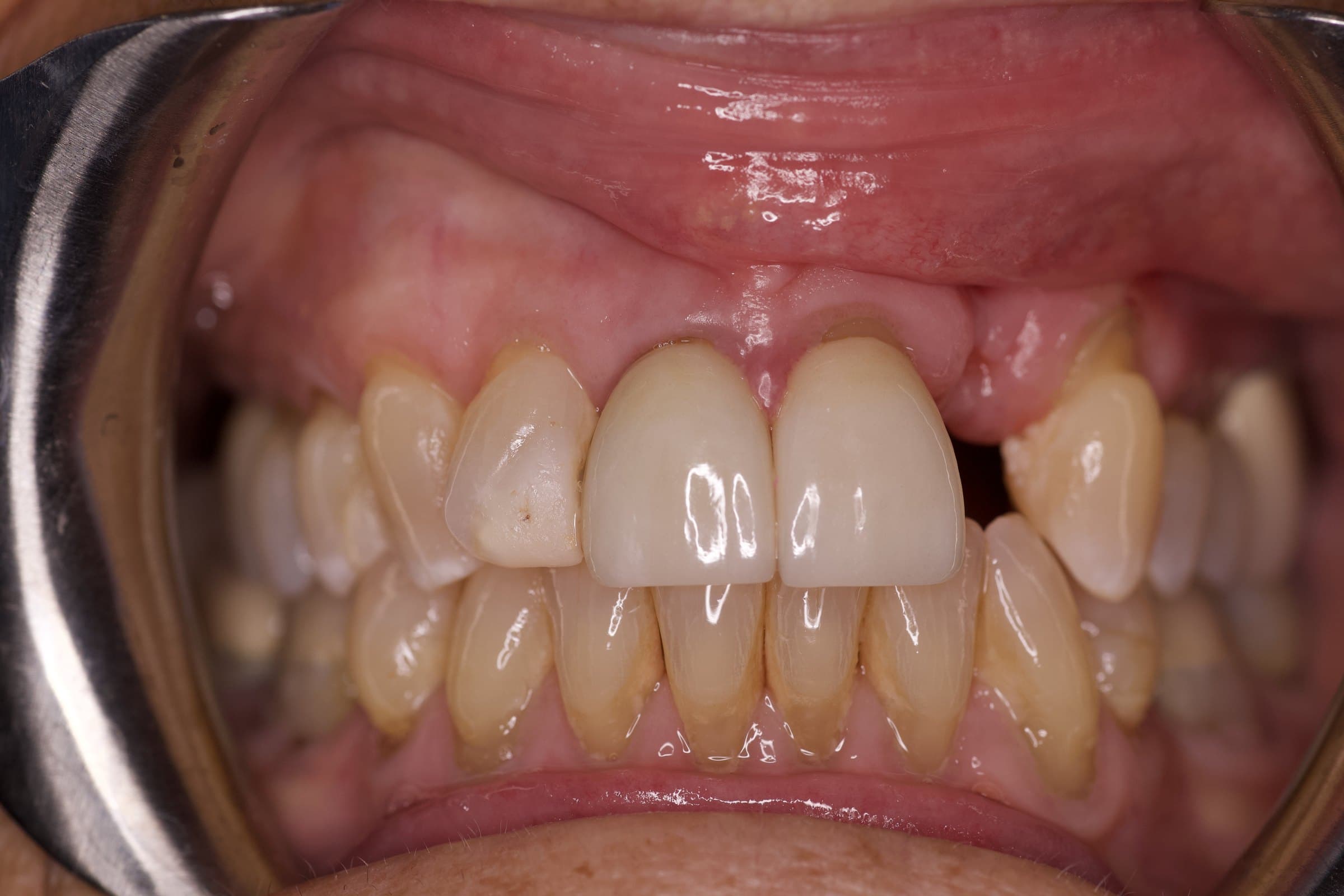
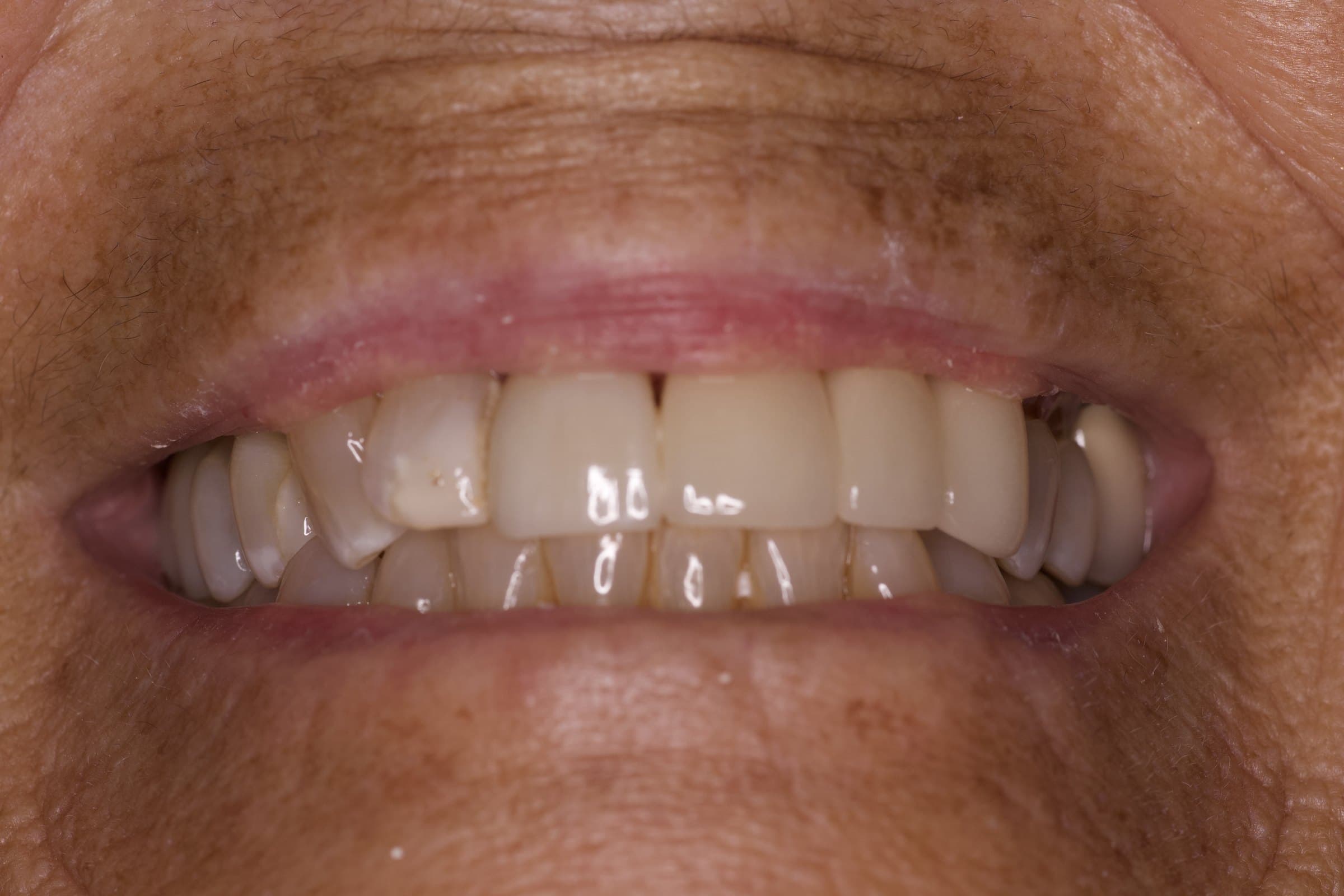
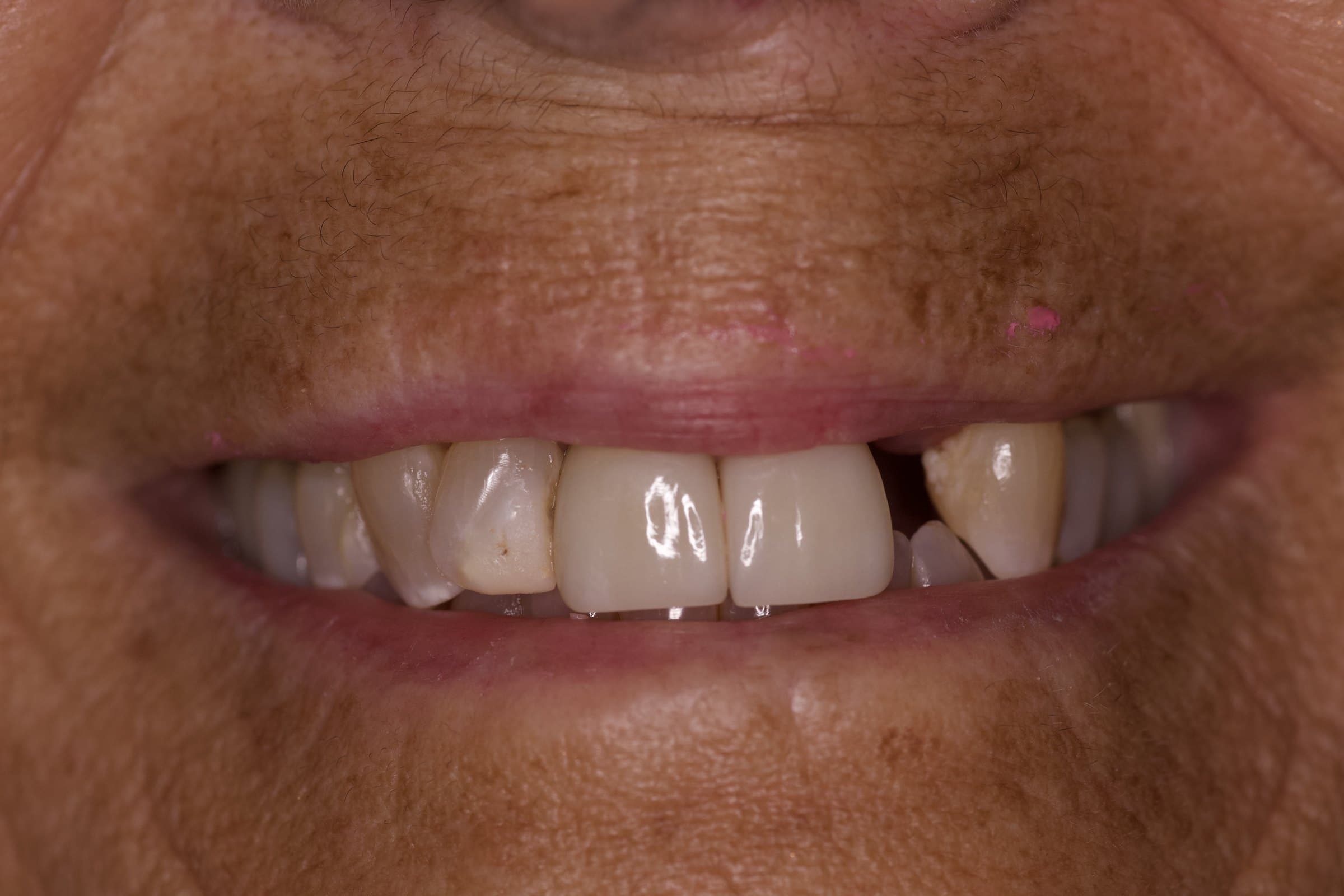
The patient was very happy with the result. The gap is closed, the bridge blends in with the neighboring front teeth, and it doesn't have to come out at night.
A note on these photos: they were taken at the time the bridge was delivered. Gum tissue around a new restoration can look a little red or puffy at that stage, and it usually settles as the area heals.
A bridge is cleaned differently from natural teeth, and that difference is most of what decides how long one lasts.
- The replacement tooth is joined to the crowns either side, so floss can't simply be dropped between them from the top
- A floss threader, superfloss, or an interdental brush is used to clean under the span instead
- Brushing twice a day still applies, as NIH oral hygiene guidance sets out, with attention to the gum line around each anchor tooth
- Regular checkups let us watch the margins of the anchor crowns, which is where problems tend to start
The bridge itself can't decay. The teeth holding it can, and decay under the edge of an anchor crown is one of the more common reasons a bridge eventually needs redoing. Gum disease and untreated grinding are the others. If you clench or grind, ask about a nightguard.
Why this result does not predict yours
This was one patient's case, not a forecast of yours. A different site, different neighboring teeth, and a different starting point lead to a different plan and a different result. What a case like this shows is the reasoning behind the choice, rather than an outcome you should expect.
Each option can work. The right one depends on the condition of the site, the neighboring teeth, your general health, and your goals.
A bridge isn't the answer for every missing tooth, and neither is an implant. The right choice depends on the condition of the site, the neighboring teeth, and your goals, and that's what an exam and imaging tell us.
What to do if you are missing a front tooth
Most bridge cases take more than one visit, because the restoration is made for your mouth rather than taken off a shelf. We'll outline the steps and the sequence for your case at the consultation rather than leaving you to guess at it.
If you're missing a tooth and unsure what your options are, we'd be glad to take a look. The office is in Altamonte Springs, a short drive from Longwood, Winter Park, Maitland, and Casselberry, and the first visit is an exam and imaging. Call (407) 774-4433 or request a free consultation.