We restored this patient's worn front teeth with conservative eMax crowns, prepared to her own existing form and bite. Her front teeth had been patched with composite bonding on and off for about fifteen years, and the wear underneath kept progressing. Another round of bonding would not have held on teeth that thin.
Years of small repairs had left her front teeth visibly worn, unevenly shaded, and structurally thin in places. Nothing about the situation was urgent or painful. It was simply the natural result of a lot of years and a lot of small fixes finally running out of runway.
Composite is a tooth-colored resin bonded directly onto the tooth and shaped by hand in a single visit. For a small chip or a worn edge it's a good repair. It's also conservative. Almost nothing has to be removed to place it. The limitation is in the material. Composite is softer than enamel and softer than ceramic. So it wears, and its surface takes up stain over time. The joint between composite and tooth is usually where that shows first.
Each repair also sits on a tooth with slightly less sound structure than it had before. In general, patching works for a long time and then stops working, because there isn't enough tooth left for a patch to hold onto. That's the point where full coverage becomes the option that lasts rather than a matter of preference.
Why full coverage, and how much tooth had to come off
A crown covers the whole tooth above the gumline. Load spreads across the remaining structure instead of concentrating at a bonded edge. Thin walls get held together rather than left to flex. Length and shape get rebuilt in one piece, with the margin placed where it can be kept clean. That's the difference between restoring a tooth and repairing a corner of it.
Preparing a tooth for a crown means reducing it so the ceramic has room to sit without looking bulky. How much comes off is a decision, not a fixed number. A standardized reduction takes the same amount everywhere. A conservative approach removes only what the restoration needs in each area, which leaves more enamel behind.
That matters for two reasons. Ceramic bonds more reliably to enamel than to dentin, so keeping enamel generally helps the bond. And a tooth that retains more of its own structure is usually less prone to sensitivity afterward. Conservative doesn't mean under-preparing, either. Too little reduction leaves ceramic too thin, and thin ceramic chips.
Why her existing bite set the design
Rather than designing a new smile from scratch, we used her existing form and bite as the blueprint for the entire procedure. That mattered for two reasons. It kept the preparations conservative, removing only what needed to come off the natural tooth structure rather than a standardized amount. And it meant the final result would function the way her bite already knew how to function, instead of asking her mouth to adapt to something new.
In general terms, your jaw muscles and your jaw joint have spent years adapting to the teeth you have. The path your teeth travel as the jaw slides sideways. Where the front teeth meet. How the back teeth share the load. All of that is learned. Change the geometry and the mouth has to relearn it. That can show up as muscle soreness, as a result that feels foreign to chew on, or as chipping where new contacts land harder than expected.
Why eMax at the front, and which teeth a crown suits
We restored the teeth with eMax crowns. eMax is a lithium disilicate ceramic known for combining strength with a very natural, light-transmitting appearance. For anterior teeth especially, that translucency is what keeps a crown from reading as fake next to the teeth around it.
Front teeth are the hardest place in the mouth to match. Natural enamel isn't one flat color. It passes light through near the edge and holds more opacity toward the gum, and a ceramic that behaves the same way disappears beside its neighbors. That's why shade and translucency often drive material choice at the front, while strength under heavy chewing load drives it at the back.
It's also why front teeth are often better served by a lab-fabricated crown than a same-day one. Both are good options in the right place, and the honest answer depends on the tooth. We'll tell you which we'd choose for yours and why.
Full coverage crowns make sense when a tooth has lost enough structure that a bonded repair won't hold. They also make sense when several front teeth need rebuilding to a matching shape and shade. They aren't the first answer for one small chip, which bonding can often handle in a single visit. They also aren't a way to correct alignment. If your teeth are crowded or your bite needs changing, that gets addressed on its own terms. Active decay and gum disease get treated before any crown is planned, because a margin on an unhealthy tooth is a short-lived margin.
What crown treatment involves and what it feels like
- Exam and records: photographs, X-rays, and a scan or impression, plus notes on how your teeth meet
- A written plan covering the material, the design, and the cost, reviewed before anything starts
- Preparation under local anesthetic, with temporaries where the plan calls for them
- Fabrication of the crowns, either in the office or at a dental laboratory depending on the case
- Try-in, where fit, shade, and shape are checked before anything is bonded permanently
- Bonding, then a careful bite check and adjustment
- A follow-up to review the tissue and the bite once everything has settled
How many visits a case like this takes follows the number of teeth prepared at a time, since the bite has to be referenced against something that has not changed.
Local anesthetic is used during preparation, so you shouldn't feel pain while the tooth is being worked on. Afterward, most patients describe tenderness in the gums and some sensitivity in the tooth. That eases as things settle. Temporaries feel different from both your own teeth and the finished crowns. That stage is the one patients ask about most. A corrected bite can feel unfamiliar for a short while even when it's right, which is exactly why the bite check and the follow-up exist.
What the photographs show, and what keeps the crowns lasting
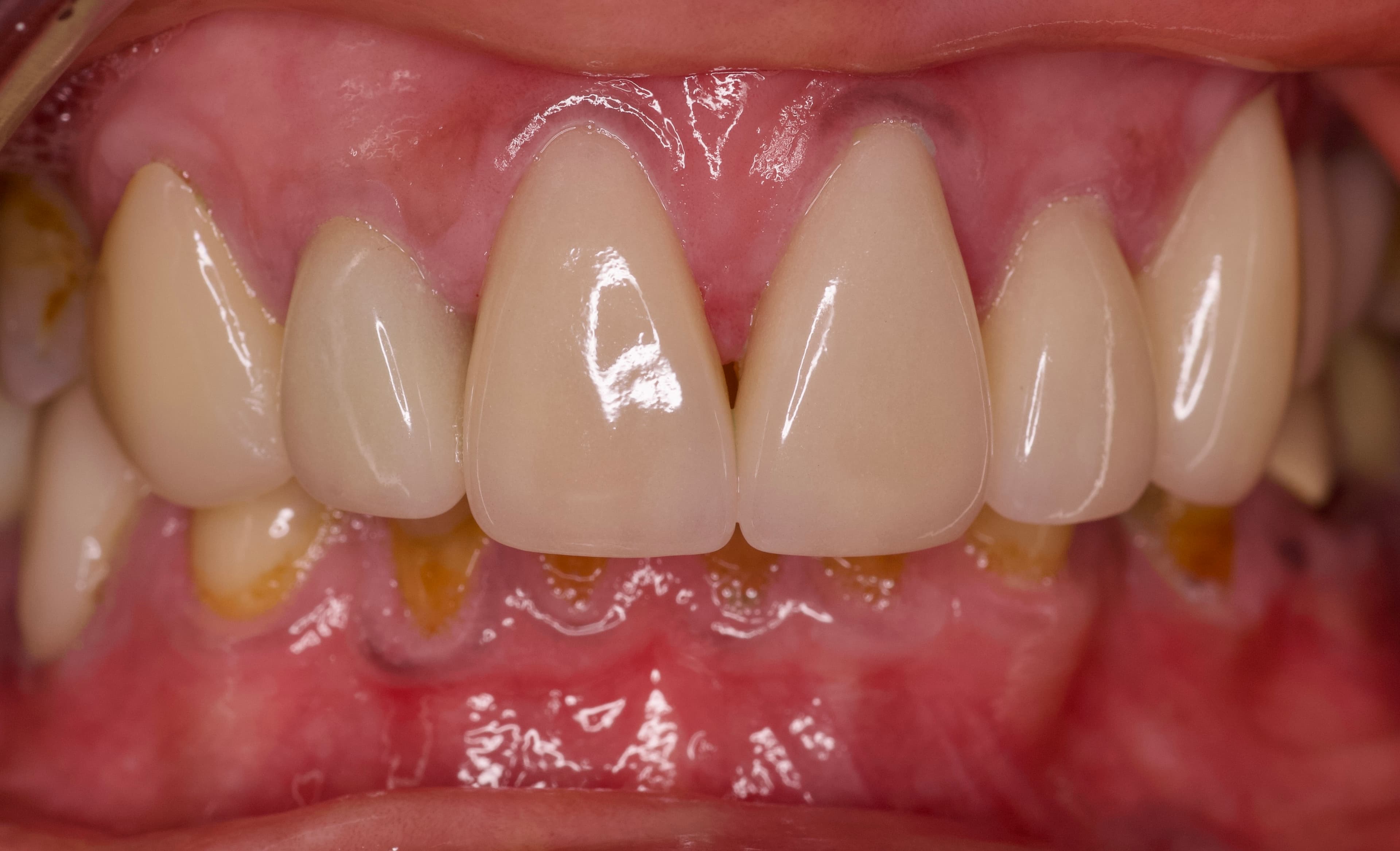
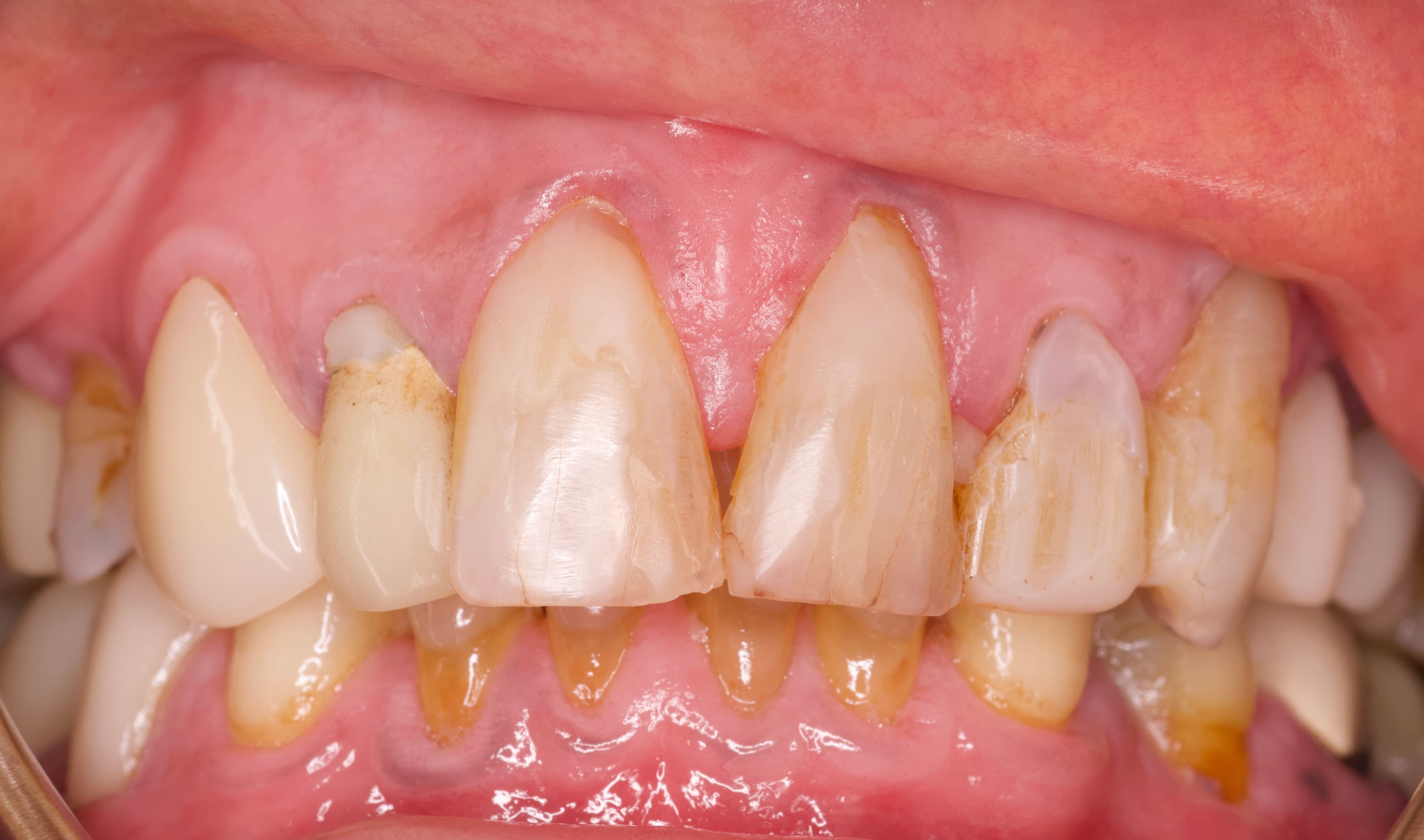
A note on this "after" photo: it was taken once the gum tissue had healed. Right after a crown appointment, gums around new crown margins often look red and puffy, because the gumline has to be retracted and handled to get a clean, dry seat. That irritation is a normal, short-lived response, not a sign of a problem with the restoration, and it settles as the tissue heals and adapts to the new margins. The healthy pink tissue you see here is what that looks like a little while later.
The final restorations look, feel, and function like her own teeth did years ago. Even, well-shaped, and comfortable against her natural bite, with the added benefit of a brighter, more even shade than the original composite patchwork ever achieved. Nothing about the outcome required changing who she looks like. It just gave her back what fifteen years of small repairs had gradually worn away.
With good care, ceramic crowns are a long-term restoration rather than a repair you expect to redo. What shortens them is predictable, and most of it is in your control.
- Grinding or clenching without a nightguard, which is a common cause of a chipped ceramic crown
- Chewing ice or hard candy, or using your front teeth to open things
- New decay at the margin where the crown meets the tooth. The crown can't decay. The tooth under it can.
- Gum disease, which moves the gum away from the margin and exposes it
- Skipped checkups, so a small problem at a margin gets found late
What this case does not predict, and where the plan would change
This is one patient with one set of starting conditions, and her result is hers. It isn't a prediction of what another mouth would look like, and it shouldn't be read as a typical outcome. What travels from a case like this is the reasoning rather than the result. Find out why the previous repairs kept failing. Remove as little tooth as the restoration allows. Let the bite that already works set the design.
Copying the existing form removes most of that problem before it starts. There are cases where the existing bite is itself the thing causing the damage. Those do need changing, and that's a different plan with different steps. The judgment call is which situation you're in, and it's made from records and an exam rather than from a photograph.
What to do if you have been patching the same teeth for years
If you've been patching the same front teeth for years, and each repair lasts less time than the one before, that pattern is worth a proper look. Another patch isn't the answer. Bring your history. We'll go through how much tooth structure is left and what your bite is doing to it. Then which options are genuinely on the table, including the ones that involve less treatment. What a plan like this costs depends on how many teeth still have enough structure to crown, and the starting figures are on our pricing page.