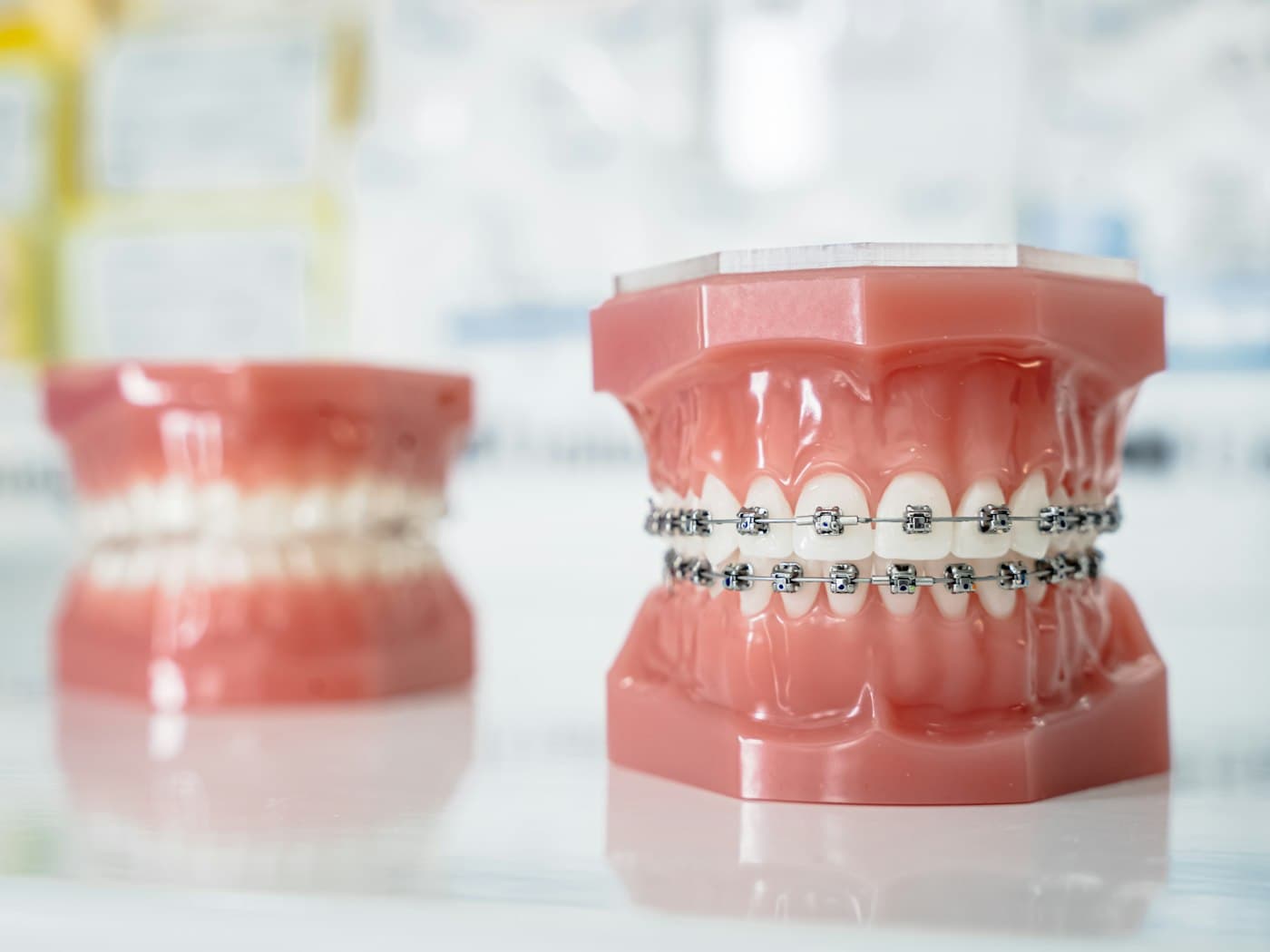
Clear aligners suit mild to moderate crowding, spacing, and minor bite issues, and they only work if you wear them 20 to 22 hours a day. Braces handle more complex movements and severe misalignment, and they stay on whether you cooperate or not. Which one fits depends on how much your teeth need to move, then on your routine.
Both traditional braces and clear aligners move teeth into better alignment, but they get there very differently. The right choice depends on your case and your lifestyle, not just personal preference.
Clear aligners are nearly invisible and don't involve wires or brackets, which means less irritation to your cheeks and lips. Traditional braces are more visible but stay in place continuously, without the discipline required to wear removable trays consistently.
One thing that shouldn't differ: your treatment should be actively monitored by a dentist, not left entirely to a mail-order kit and a smartphone app. Direct-to-consumer kits skip the in-person exam, which is where problems like gum disease, decay, or a bite issue get caught.
Doctor-directed treatment means someone is actually checking your progress, looking at your gums, and adjusting the plan if something isn't tracking as expected. Moving teeth over unresolved decay or active gum disease is how straightening goes wrong.
What living with aligners asks of you
A digital scan is where the two paths separate: trays are manufactured as one sequence up front, while braces get adjusted one visit at a time. From the scan we build your plan and show you a projection of the result, then a series of custom trays is made. You switch to the next tray on schedule, and Dr. Shah tracks your progress and adjusts the plan if something isn't moving as expected. We use CandidPro aligners, planned and monitored here rather than mailed to you.
Fit is what to watch in a new tray, because the plastic was shaped around where the plan expects each tooth to be by then. If a tray won't seat properly, or a tooth isn't tracking the way the plan expected, tell us rather than pushing on to the next one. The alternative is a series that keeps running on an assumption the teeth stopped matching several trays ago.
Each tray pushes hardest when it first goes on and loses its grip as the tooth moves toward the shape of the plastic, so the series runs on a schedule rather than on feel. Rinse the trays in cool water rather than hot, since heat can distort the plastic enough to change the way it grips. Carry the case, because most lost aligners are lost in a napkin.
The 20 to 22 hours is the part people underestimate. Four hours out of the trays each day is already more than the plan allows. If your days involve long lunches, constant snacking, or work where you can't easily take trays out and clean your teeth, be honest with yourself about that before choosing.
What braces are like day to day, and what switching involves
Braces work the other way around. There's nothing to remember, because nothing comes out. What you give up is food. Anything hard, sticky, or chewy enough to pull a bracket loose is off the list for the duration.
Cleaning takes longer, since you're brushing and flossing around wires and brackets. Expect soreness for a few days after each adjustment, and the occasional wire end that needs a quick visit to tuck back down. None of that is dramatic. It's just a different kind of effort from remembering to put trays back in.
Sometimes. If aligners aren't achieving a movement the plan depended on, braces can take over from where you've got to. The reverse happens as well, with braces coming off early and aligners finishing the detail. Neither switch is free and neither is a failure. It's far better to raise it early than to finish a plan that didn't land.
Which cases each one can move
- Clear aligners work well for mild to moderate crowding, spacing, and minor bite issues
- Traditional braces can address more complex movements and severe misalignment
- Aligners require consistent daily wear, typically 20 to 22 hours, to stay on schedule
- Braces don't rely on patient compliance in the same way, since they can't be removed
Aligners aren't a lesser version of braces. They're a different tool with a narrower range. A tray grips the outside of the crown, so a tooth that has to spin in place or cross a gap gives the plastic very little to push against without bonded attachments to hold on to. Elastics worn between the arches pull one jaw's teeth against the other, and that is the kind of force a tray sitting on a single arch cannot produce.
- Adults who want treatment to stay discreet at work, and who can keep to the wear time
- People who had braces years ago and whose teeth have drifted since
- Teenagers, and anyone who'd rather not manage a removable appliance at all
- Cases where the movement needed is beyond what trays can deliver, which means braces
- Either one beats leaving crowded teeth that are hard to clean properly
Retainers, timelines, and what affects the cost
Teeth drift back. That's true after aligners and after braces, and it's the stage patients most often skip. The fibers and bone holding a tooth take time to reorganize around its new position, which is why retention is a stage of treatment and not an accessory. Teeth that have shifted since previous orthodontic work are one of the most common reasons people start aligner treatment in the first place.
It varies. Braces and trays land in a broadly similar range for the same case, so choosing between them is rarely a way to finish sooner. The length depends on how far the teeth have to travel. With aligners it also depends on you, because hours spent out of the trays push the schedule back. A timeline quoted before anybody has looked at your teeth is guesswork, which is the first thing to be wary of in an online aligner quiz.
For either option, cost tracks how much movement your case needs and how long treatment runs. A few months of minor correction isn't the same spend as a case that runs over a year. A published figure covers a straightforward case, so treat our pricing page as a floor rather than a quote for your teeth. Financing options are available.
When these are the wrong tool
Straightening teeth doesn't change their color or their shape, and it won't rebuild a chipped edge. If what bothers you is the shade rather than the position, aligners and braces are both the wrong tool. Whitening, bonding, or veneers are the conversation to have instead. Often the order matters: move the teeth first, then decide whether anything cosmetic is still needed.
Braces are also the safer choice if you already know you won't keep removable trays in for 20 to 22 hours a day. At your consultation we'll tell you honestly which is the right tool for your teeth. If your case needs braces or a referral to an orthodontist, that's what we'll say.
How to find out which one fits your case
Neither option fixes a tooth that's loose from gum disease, and neither should start over active decay. That's part of why the in-person exam comes first.
The best way to know is a consultation and a digital scan. From there we can show you a realistic projection of your results, and tell you whether aligners will do what you want or whether braces will do it better. Call (407) 774-4433 or request a consultation online.