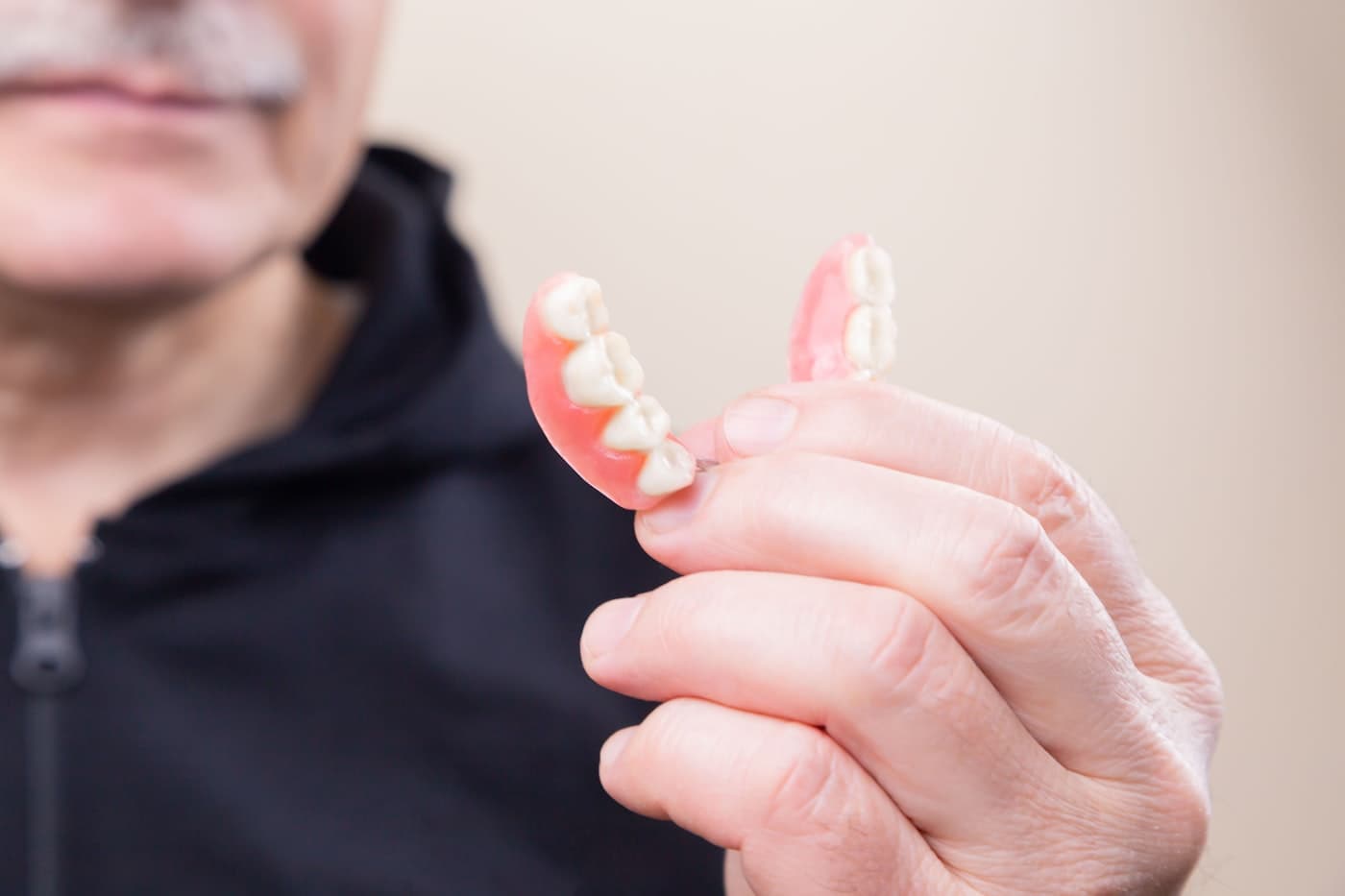
Neither is better for everyone, and the long-term answer tracks how much bone you have. Full-arch implants are fixed to posts in your jaw, so they hold better and help preserve bone. Traditional dentures rest on the gums and come out, and they cost less up front with no surgery. The choice depends on your bone and your budget.
If you're missing most or all of the teeth in an arch, both are real options. They solve the same problem in very different ways, and the difference matters more the further out you look.
Full-arch implants are permanently anchored to a small number of implant posts, so they function much closer to natural teeth. No slipping, no adhesives, and nothing to take out at night. Traditional dentures rest on the gums and can shift, especially over time as your jawbone changes shape.
Lower dentures are the harder case. There's less ridge to hold onto and the tongue works against them, so a lower denture that stays put is less common than an upper one that does. If your complaint is a lower denture that moves when you eat, that's the problem implants solve most convincingly.
The right choice depends on your bone health, your budget, and how much stability matters to you day to day. We'll walk through the honest tradeoffs for your situation, including when a denture is the better answer for you.
What happens to your bone, and what each route costs over time
This is the factor most patients don't hear about upfront. Tooth roots stimulate the jawbone, and without that stimulation bone gradually resorbs. Implants replace that stimulation and help preserve bone volume. Traditional dentures don't, which is part of why dentures often need relining or replacement as the jaw's shape changes.
Dentures cost less upfront but typically need adjustment or replacement every several years. Full-arch implants cost more initially but are designed to last much longer, which changes the long-term math more than the sticker price alone suggests.
That math only helps you if you can act on it. If the up-front figure for a fixed arch isn't available to you, the better treatment is the one you can actually have. Years spent saving for implants are years spent without teeth, and that trade is rarely worth it.
For implants: how many posts the arch needs, whether extractions or grafting come first, and one arch or both. Then the material of the finished teeth, and whether a temporary arch is made while you heal. For dentures: whether teeth need removing, and how much adjustment the fit takes. Starting prices are on our pricing page, financing options are available, and the figure for your plan is confirmed in writing at your consultation.
Bone keeps resorbing whether or not you wear a denture, and the ridge gets flatter over time. Chewing narrows your diet, which has knock-on effects. Any teeth you still have take load they weren't built to carry alone and tend to wear or fracture. An ill-fitting denture gets worse rather than better. And the less bone there is, the fewer options remain, so waiting tends to close doors rather than keep them open.
What the implant route involves, and who it rules out
- Imaging that measures the bone above the nerve on a lower arch and below the sinus on an upper one
- The number of implant posts the plan calls for, since a fixed arch and a snap-on denture need different counts
- Any extractions that are still needed, and healing time for the sites
- Guided implant placement, planned digitally for precision
- Healing, during which the implants fuse with the bone. This often takes a few months.
- Placement of your final fixed arch
- Regular checkups to keep the implants and the gums around them healthy
In select cases a full-arch restoration can be completed in a single day. Whether that's right for you depends on your bone and your overall health, which is what the imaging and the exam are for.
Implant placement is done with local anesthetic, and we go over sedation options that fit your case before the day. You shouldn't feel pain during placement. Swelling after implant surgery comes from the work done in the bone, not the stitches, and it tends to peak a day or two afterward rather than on the day itself. A full arch is more surgery than a single implant, so expect more of that. Keep a few quiet days around it rather than booking it in front of something that matters.
Active gum disease gets treated before implants are placed. Uncontrolled diabetes and smoking both affect healing, and some medical conditions and medications affect bone. Thin or shrunken bone can often be built up with grafting, but that adds time and cost, and not everyone wants it. We look at your whole picture rather than giving a quick yes or no, and if implants aren't the right answer we'll tell you that.
What the denture route involves, and how long each route takes
- Impressions or a scan of the ridge
- Extractions and healing first, if teeth still need removing
- A try-in, so you can see the look and check the bite before anything is finished
- Delivery, then a series of adjustments as your mouth settles around the new denture
- Relines over time, as the shape of the ridge changes underneath
- A remake eventually, because the fit follows the bone
A denture can be delivered relatively quickly, with adjustments afterward as the fit settles. A fixed arch takes longer, because the implants need months to fuse before the final teeth go on, and any extractions or grafting add time ahead of that. Ask exactly what you'll be wearing during the gap and for how long. That detail affects daily life more than the finish date does.
Implant-supported dentures combine some of both. It's a removable denture that snaps securely onto implants, so you get more stability than a traditional denture without the cost of a full fixed arch. It's worth looking at for a lower arch in particular, where traditional dentures struggle most.
What each one feels like day to day, and how you clean it
A fixed arch stays in your mouth and you clean it there. Most patients eat close to normally and stop thinking about it, though it's a prosthesis rather than a set of natural teeth and it feels like one at first. Nothing comes out at night.
Upper dentures cover the roof of the mouth and a fixed arch does not, which is the contrast patients report noticing most at meals. Sticky and hard foods are the usual complaints. Adhesive helps some people and frustrates others. Dentures come out to be cleaned, and most patients leave them out overnight so the tissue underneath can recover.
- A fixed arch is cleaned daily in your mouth, including under and around the bridge, which takes a little technique to learn
- Implants can't decay, but the gum and bone around them can still get infected if they're neglected
- Dentures are cleaned out of the mouth, and the gums underneath need cleaning too
- Both need regular checkups. For implants, that's how a problem around a post gets caught while it's still small.
When a denture is the better choice
This part gets skipped in most comparisons, so here it is plainly. Dentures win in real situations, and price is only one of them.
- There isn't enough bone for implants and you'd rather not go through grafting to build it
- A health condition or a medication makes surgery or healing a greater risk
- You want to be treated without a surgical phase and without months of healing in the middle
- The up-front cost of a fixed arch isn't realistic for you now
- You already wear a denture that fits well and you're happy with it. Replacing something that works isn't an upgrade.
- You're not ready to decide. A denture can be remade or converted later. Implants placed to the wrong plan can't be unplaced.
How to decide
- Get the imaging first. Your bone decides more of this than your preference does.
- Ask for both plans in writing, with the long-term maintenance costed in, not just the first figure
- Be honest about what bothers you most: the slipping, the palate coverage, the cost, or the surgery itself
- Ask what the fallback is if the first plan doesn't go as expected